

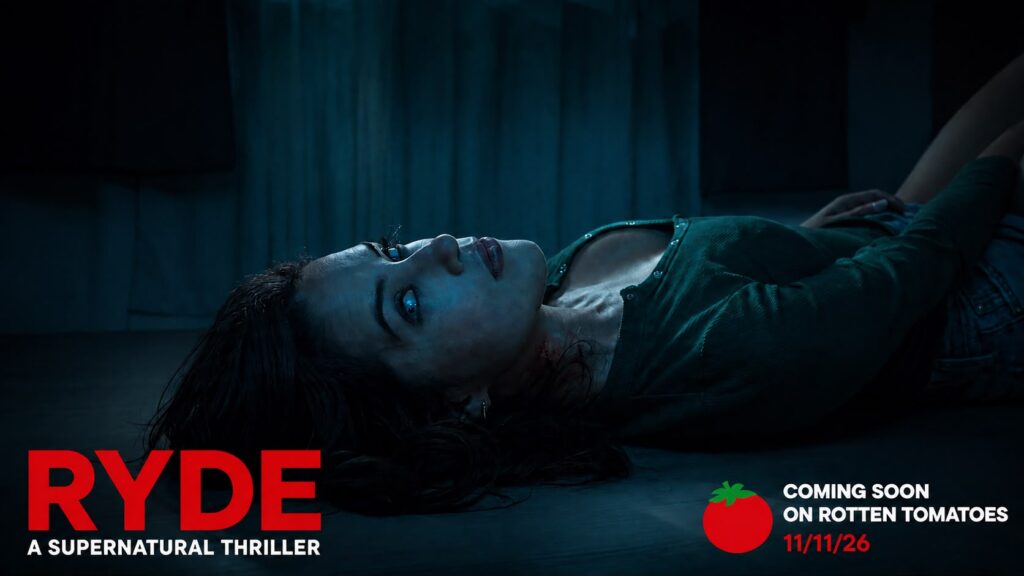
Los Angeles empties out in a particular way. The bars close, the valet lines thin, and the city hands itself over to a fleet of anonymous sedans carrying strangers home through forty miles of sodium light. It’s the least examined ritual in town. Every night, thousands of people stand alone on curbs, match three letters on a license plate to a screen, and surrender their route, their speed, and their door locks to someone they will know for exactly one trip. RYDE, an upcoming supernatural thriller, looks at that ritual and asks the question the app is designed to keep anyone from asking: who is actually driving?
The film opens its story with almost nothing in its pockets, and that’s a compliment. A young woman leaves a party mid-argument with her boyfriend, requests a ride, and boards the car that matches her screen. The driver is polite, professional, and not what he appears to be. That’s the pitch in full. No castle, no cursed bloodline laid out in a prologue, no mythology dump. Just a pickup, a passenger, and a stretch of city between her and home that turns out to be longer than any map can measure.
The driver is the film’s sharpest construction precisely because he’s barely constructed at all. He presents as the job itself: unremarkable, unhurried, one of the thousand interchangeable professionals circling the city at any hour. RYDE withholds his history for as long as it can, and the withholding is the point. Passengers don’t order a person. They order a function with a first name and a star rating, and the entire economy runs on nobody thinking about the difference.
Underneath the modern surface, the film is working the genre’s most durable law. A vampire cannot enter without an invitation. That rule outlived Nosferatu, outlived the Hammer years, outlived every sun-sparkled revision since, and RYDE’s contribution is to notice that the invitation has been fully automated. She summoned him from an app. She confirmed his plate. She opened his door with her own hand at 1 a.m. and pulled it shut behind her. The threshold didn’t vanish from the mythology. It grew wheels and a fare estimate.
And it had to be this city. Every Angeleno has the story: the ride that felt wrong in a way that never made it into words, the silence with weight, the turn that didn’t track, all of it overruled because the app had the route and the little dot was moving and the system has never once been wrong. RYDE is set inside that overruled instinct, and it stays there, patiently, letting the wrongness accumulate one surface street at a time.
The production, which counts James Marchioni among its executive producers, is keeping the ride’s ending sealed, and the secrecy is the right call. The official site at RydeMovie.com says only what it needs to, in a tagline that doubles as a threat: some rydes last forever. The ending was never where the horror lived anyway. It lives at the curb, in the four seconds of verification that pass for safety, in the moment so automatic it stopped counting as a decision: headlights, matching plate, door shut.
For a century, the vampire’s one weakness was that he had to be asked. RYDE understands that we ask now, constantly, by the tens of thousands, every single night. He doesn’t stand outside anymore. He’s three minutes away, and your phone just told you he’s arrived.