


Maximiliaan van Kuyk’s IOU Marker, built quietly in Miami, is betting that the fix for late payments starts before the invoice ever goes out.
The email almost always starts with an apology. “So sorry, our finance team is backed up, we’ll get this paid this week, promise.” Then nothing. Then a polite Slack message that takes an hour to write because it has to sound friendly and firm and not too needy. Two weeks pass. The invoice is now sixty days old. The contractor is still working with the same client. Meanwhile rent is due, payroll is due, and the credit card balance keeps growing.
For people who work for themselves, that loop is the job after the job. It is the unpaid second shift nobody warned them about.
The numbers back up what they already feel. Remote’s 2025 Contractor Management Report found that 85 percent of freelancers see their invoices paid late at least some of the time. Intuit QuickBooks puts the average unpaid invoice load on a single American small business at roughly $17,500 on any given day. Nearly half of those businesses are sitting on something overdue by more than thirty days.
The strange part is that most of it has nothing to do with clients who refuse to pay. Most clients intend to pay. They simply don’t, on time, and the cost of paying late lands almost entirely on the person waiting.
Maximiliaan van Kuyk has been around this problem long enough to see the shape of it. A serial entrepreneur now building out of Miami, he kept hearing variations of the same story from people in different fields. A PR agency owner chasing a final balance for six months. A web developer billing a large client and having to keep reminding them of the open invoice. A small production company running their own shop, owed money by a brand client who kept saying the check was cut.
 “You can be good at what you do and still lose money because someone else is bad at paying,” van Kuyk said. “That shouldn’t be how this works.”
His response is a company called IOU Marker, currently in beta and now opening a seed round. The pitch is not about prettier invoices. Van Kuyk treats late payments as a problem with the system itself, not the bill. If there is no accountability for people to pay on time, they are incentivized to just keep their cashflow high at the expense of the other parties’ cashflow.
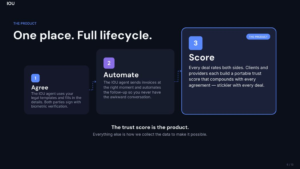
The product walks through three main stages. First, the agreement: The platform handles the counter signing of a custom uploaded agreement or of one of the service agreement templates it provides and uses AI to extract payment terms and schedule invoices. Then the automation kicks in. Invoices are automatically generated with payment links and go out when the work ships. Automated follow up tied to the context of the deal goes out before due dates pass. The follow up stops being the small business owner’s job and starts becoming the software’s responsibility.
The third stage is what really separates IOU Marker from the rest of the invoicing world. Every client and every service provider builds a Trust Score and reviews over time, similar to how hosts and guests rate each other on Airbnb, based on how they actually behave once a contract is signed. Pay on time, it goes up. Pay late, it slips. Ghost an invoice, it falls hard. This creates a level of social accountability that pushes people to keep their word and not delay payments without reason. What the team at IOU saw is that when these situations turn sour, they often spill onto X, LinkedIn, or private industry groups, so the system gets ahead of that.
The company is betting people will handle contracts the same place they already handle everything else. IOU Marker is building AI agents that work directly inside WhatsApp and Slack, the two apps where most informal deals already happen. Send an agreement in a thread. Get it signed without leaving the chat. The invoice goes out when the work ships. If the date passes, an AI agent in the same chat takes over the follow up. The contractor never has to write the awkward “just checking in” message again. Anyone who has freelanced long enough knows exactly what that message feels like.
“Most freelancers or small business owners aren’t bad at their work,” he said. “They’re bad at the part where they have to be a contract lawyer, accounts receivables, and an accountant all in the same afternoon. We’re trying to take those tasks back off their plate.”
The Trust Score is the part of the product that pushes against something bigger than software. For years, freelancers and business owners have warned each other in private group chats about clients who don’t pay. A public score pulls that whisper network into the open. A bookkeeper in one city can see what a marketing agency in another actually does, not just what it promises. For contractors and small businesses, a strong score becomes a kind of resume. For clients, paying late starts to actually mean something.
Whether clients will accept having their payment behavior attached to a public score is another question. Some will push back. Hard. Larger companies in particular have built entire accounts payable departments around the comfort of paying whenever they feel like it. A visible payment history changes that dynamic.
The company has started to draw attention as it moves out of beta. Coverage has come from Refresh Miami, Impact Wealth, and GigWise. The seed round opens at a useful moment. Independent workers now make up close to half of the global labor force. Most of the systems freelancers rely on were built for large companies, not independent workers.
What IOU is really building, van Kuyk argues, is not just a paperwork tool. It is a living record of how people behave professionally. Right now a client’s payment history lives in a private exchange between them and whichever freelancer they hired last. When that relationship sours, it sours behind closed doors. The contractor moves on. The client moves on. Nothing changes for the next person who signs a contract with them.
A score that travels with you changes the math. Pay your contractors well and that record is visible the next time you go looking for a designer or a developer or a freelance editor. Stiff them, and that record is visible too.
“Right now, the only person who knows you pay late is the person waiting on the money,” van Kuyk said. “When we are at scale, that will not be the case. It will become much harder to run an operation that systematically pays late or stiffs people.”